
Batching and conveying system (application in the pharmaceutical and biotechnology industries)
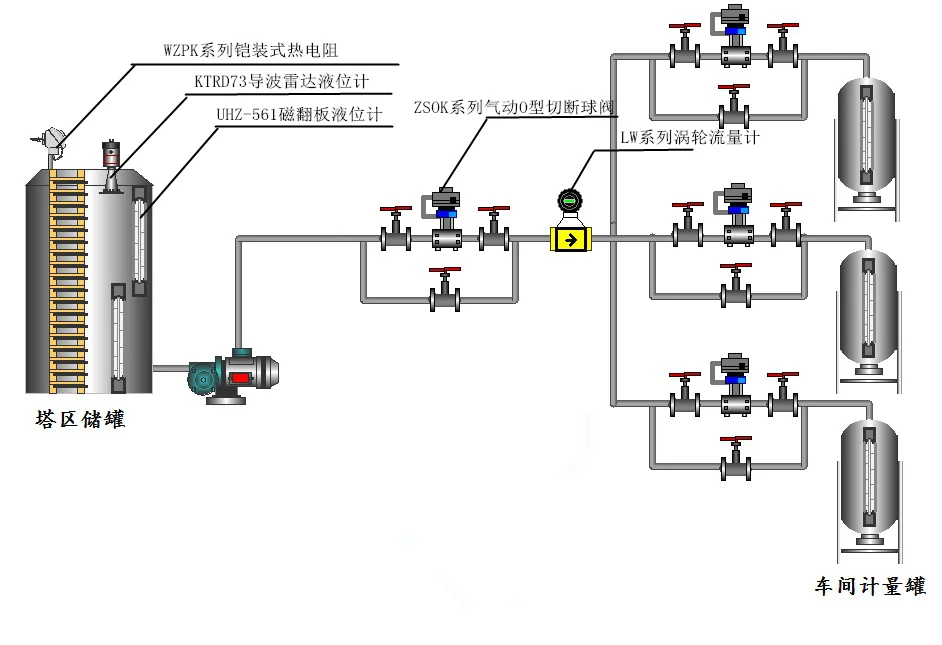
The batching and conveying system is an online measurement and dynamic metering system that integrates conveying, metering, batching, quantitative dosing and other functions. It is widely used in building materials, chemicals, metallurgy, mining, electric power, food, feed processing and other industries.
Design overview:
The storage tanks in the tank farm are fitted with radar level gauges and magnetic flap level gauges to measure the material level. The metering tanks in the workshop are fitted with magnetic flap level gauges to measure the level, and output high-level and low-level alarms that are interlocked to stop the pump.
When material is transferred from the tank farm to the workshop, the flow is measured by the flow meter on the pipeline. When the flow reaches the required quantity, the valve is closed and the pump is stopped automatically to complete the transfer.
1. Temperature and level measurement of tank farm storage tanks and workshop metering tanks
The material tanks use KTRD73 Series radar level gauges, UHZ-561 magnetic flap level gauges and WZPK Series sheathed RTDs, and the workshop metering tanks use magnetic flap level gauges, to measure level and temperature. These output 4–20 mA signals to the SM331 analog input module. The CPU calculates the level height through data processing and sends it to the host computer for display.
2. Display of storage tank and metering tank level and the corresponding volume (or weight)
In addition to displaying the level height, the host computer can calculate the material volume from the cross-sectional area of the tank (and the weight from the density) and display it. The remaining capacity (or weight) of the tank can also be measured and displayed, providing reference data for the tank truck unloading quantity and the workshop feed quantity.
Note: The calculated volume (or weight) will have some error because of factors such as changes in material density and the shape of the tank.
3. Storage tank high and low level alarms, metering tank high level alarm and interlocked pump stop
The magnetic flap level gauges on the storage tanks have high and low level alarm switches, and the magnetic flap level gauges on the metering tanks have a high level alarm switch. During tank truck unloading, the pump is stopped when the level reaches the high limit to prevent the tank from overflowing. During feeding to the workshop, the pump is stopped on a storage tank low level alarm or a metering tank high level alarm to prevent the pump from running dry with no load or the metering tank from overflowing.
An alarm can also be set on the level height measured by the storage tank radar level gauge, so that the pump can also be stopped at high and low levels in automatic mode.
Note 1: In fully manual mode, tank truck unloading may cause a storage tank high level pump stop, after which the pump cannot be started. The tank is then full but material cannot be transferred to the workshop. The system hardware includes a bypass device, and switching on the bypass device allows material to be transferred manually to the workshop as normal. When the level has dropped after the transfer and the high level alarm has cleared, the operator must return the bypass device to its original state. In this situation, material can also be drawn off by drum filling to lower the level and clear the alarm.
Note 2: In fully manual mode, a high level alarm on any workshop metering tank stops the pump, so material cannot be transferred to the other metering tanks that are not full. In this situation, it is recommended not to transfer too much during manual transfer, so as not to cause an alarm pump stop. If the pump has been stopped by an alarm, it is recommended to use part of the material first to clear the alarm.
4. Level alarms and interlocked pump stop in manual mode
In fully manual mode, the storage tank high and low levels and the metering tank high level can also stop the pump by interlock. However, the following two situations may occur:
1. In fully manual mode, tank truck unloading may cause a storage tank high level pump stop, after which the pump cannot be started. The tank is then full but material cannot be transferred to the workshop. The system hardware includes a bypass device, and switching on the bypass device allows material to be transferred manually to the workshop as normal. When the level has dropped after the transfer and the high level alarm has cleared, the operator must return the bypass device to its original state. In this situation, material can also be drawn off by drum filling to lower the level and clear the alarm.
2. In fully manual mode, a high level alarm on any workshop metering tank stops the pump, so material cannot be transferred to the other metering tanks that are not full. In this situation, it is recommended not to transfer too much during manual transfer, so as not to cause an alarm pump stop. If the pump has been stopped by an alarm, it is recommended to use part of the material first to clear the alarm.
5. Quantitative transfer of material to the designated workshop metering tank by flow meter
The operator first sets the manual valves to the correct positions, then selects the quantitative transfer mode on the computer, sets the transfer quantity and the target workshop metering tank, and starts the transfer.
After the transfer starts, the system first automatically opens the pump outlet valve and the target metering tank valve (add valve link). Only after the system has confirmed the valve-open signals is the pump started and the material transferred.
When material flows through the flow meter, the flow meter measures the flow of material passing through (add flow meter link). When the flow reaches the set quantity, the pump is first stopped automatically. After the pump has stopped, the pump outlet valve and the valve on the target tank are closed, and one quantitative feed cycle is complete.
After each transfer is completed, the computer records the name of the material delivered, the start and stop times, the set weight, the actual delivered weight, the operator and other data for later query.
During material transfer, on a tank farm storage tank low level alarm or a workshop metering tank high level alarm, the transfer is stopped whether or not the flow has reached the set quantity, to prevent the material pump from running dry with no load or the metering tank from overflowing.
6. Local manual and semi-automatic control in the drum filling area and the unloading area
The pump has to be started and stopped in the drum filling area and the unloading area, and this operation must be carried out promptly, so local manual operation is done nearby.
Drum filling and unloading can also be controlled semi-automatically. The control method is as follows:
1. Drum filling: The operator first selects the drum filling mode on the computer. The system decides from the level height whether the pump needs to be started. When the level is above the set value, the pump does not need to be started. When the level is below the set value, the pump needs to be started. After the manual drum filling signal valve is opened, the pneumatic ball valve (and the pump) is opened automatically and drum filling starts. When the drum is full and the manual signal valve is closed, the pneumatic ball valve (and the pump) is closed automatically, and one drum filling cycle is complete.
2. Unloading: The operator first selects the unloading mode on the computer. Because the remaining capacity (or weight) of the storage tank is displayed, the operator can set on the computer the quantity of material to enter the storage tank, and unloading then runs automatically. The pump is stopped automatically when the quantity of material received reaches the set value or when the level height reaches the high level alarm.
7. Manual/automatic switching
Every raw material in the system has a hardware manual/automatic switching function and is normally in automatic mode. Only when a system function is abnormal or has failed can the operator switch to manual mode, so that the operator can start and stop the pump manually on site to transfer raw material to the workshop. In manual mode, the computer does not meter or record data.
8. Emergency stop on site and in the central control room
1. The manual/automatic selector switch for each raw material in the system has a middle neutral position, which can be used as an emergency stop for that single line. When the switch is in the neutral position, the system is in standby and there is no output in either manual or automatic operation. When the system is switched from manual or automatic mode to the neutral position, the system goes into standby, all current outputs are cut off and the pump also stops.
2. An emergency stop button is installed on the main control cabinet of the system. In an emergency, when the operator presses the emergency stop button, the power supply to the system is cut off and all hardware stops working. After the situation has been cleared, the emergency stop switch is reset and the system is powered up again and put back into operation.
3. An emergency stop switch is also installed in each workshop. When any of these switches is pressed, all system actions stop immediately. All automatic material transfers in progress are stopped. Once the operator has determined which material transfer the fault occurred in, the operator uses the computer to lock the transfer of that material and the transfer function to that workshop, and releases the transfer function for the other materials, so that the other materials can be transferred normally but cannot be transferred to the faulty workshop. This is because the emergency stop switch cannot be pressed a second time until the fault has been cleared. After the fault has been cleared, the transfer functions for that workshop and the corresponding material are restored.
9. Data display, transfer records, record query and other functions on the computer
The computer provides basic functions such as displaying all storage tank levels, instantaneous flow, cumulative flow and level alarm data. After each raw material transfer is completed, the host computer automatically records the number of the source raw material tank, the number of the target intermediate tank for the delivered raw material, the start and stop times, the set weight, the actual delivered weight and other data for query and printing.
Tell us the medium, range and connection
We reply with a suitable model and a quotation. Pressure port, output signal and cable length can be made to suit your equipment.